|
|
You Are Here » Constipation » Constipation and Hemorrhoids
Constipation
Contents of this Article
Constipation and Hemorrhoids
What are Hemorrhoids?
Hemorrhoids, also called piles, are painful, dilated, swollen, and inflamed veins in the lower portion of the rectum or anus.
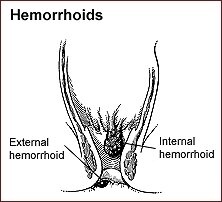
Hemorrhoids are common in both men and women. About half of the population has hemorrhoids by the age of 50, however, hemorrhoids can develop at any age, with incidences increasing after the age of 30.
Causes of Hemorrhoids
- Constipation - straining to move stool during bowel movements - the most common cause of hemorrhoids.
- Pregnancy -
- Pregnant women - the pressure of the fetus on the abdomen, as well as hormonal changes, cause the hemorrhoidal vessels to enlarge. These vessels are also placed under severe pressure during childbirth. For most women, however, hemorrhoids caused by pregnancy are a temporary problem.
- Aging.
- Chronic constipation or diarrhea.
- Anal intercourse.
- Sitting for long periods of time on the toilet.
- Obesity.
- Exertion such as lifting heavy objects, or weight lifting.
Hemorrhoids are either inside the rectum - internal - or under the skin around the outside opening of the anus - external.
-
Internal Hemorrhoids - found further inside the rectum, are usually not painful, you may not even know you have them unless they start to bleed. The most common symptom of internal hemorrhoids is bright red blood covering the stool, on toilet paper, or in the toilet bowl.
Internal hemorrhoids can be painful when straining during a bowel movement causes a small amount of intestinal lining to push out from the anal opening. This condition, known as rectal prolapse, may lead to secretion of mucus from the anus. Usually eliminating the cause of the prolapse, such as straining or coughing, is the only treatment necessary.
Severe or chronic (lasting a long time) prolapse requires surgery to strengthen and tighten the anal sphincter muscle or to repair the prolapsed lining.
-
External Hemorrhoids - round, purple, swellings under the skin around the opening of the anus. External hemorrhoids are usually tender to the touch, can itch, and can be painful, especially during a bowel movement. Excessive straining, rubbing, or cleaning around the area may cause irritation with bleeding and/or itching, which may produce a vicious cycle of symptoms. Draining mucus may also cause itching.
Severe or chronic (lasting a long time) prolapse requires surgery to strengthen and tighten the anal sphincter muscle or to repair the prolapsed lining.
The Best Way to Prevent Hemorrhoids
- Empty bowels as soon as possible after the urge occurs.
- Keep stools soft so they pass easily, thus decreasing pressure and straining. Increased fiber and fluids in the diet help reduce constipation and straining by producing stools that are softer and easier to pass.
- Eating the right amount of fiber and drinking six to eight glasses of fluid - not alcohol - result in softer, bulkier stools. A softer stool makes emptying the bowels easier and lessens the pressure on hemorrhoids caused by straining. Eliminating straining also helps prevent the hemorrhoids from protruding.
- Good sources of fiber are fruits, vegetables, and whole grains. In addition, doctors may suggest a bulk stool softener or a fiber supplement such as psyllium (Metamucil) or methylcellulose (Citrucel).
- Exercise, including walking.
Symptoms of Hemorrhoids
Hemorrhoids usually are not dangerous or life threatening. In most cases, hemorrhoidal symptoms will go away within a few days. Many people have hemorrhoids, not all experience symptoms:
- Most common symptoms of hemorrhoids:
- Pain or discomfort, itching or irritation in the anal area.
- Swelling around the anus.
- Leakage of feces.
- Painless bleeding during bowel movements.
- Bright red blood covering the stool, on toilet paper, or in the toilet bowl.
- An internal hemorrhoid may protrude through the anus outside the body, becoming irritated and painful. This is known as a protruding hemorrhoid.
- Painful swelling or a hard lump around the anus that results when a blood clot forms. This condition is known as a thrombosed external hemorrhoid.
Many anorectal problems, including anal fissures, fistulae, abscesses, or pruritus ani, have similar symptoms and are incorrectly referred to as hemorrhoids.
- Anal fissure - a tear or small split in the skin around the anus caused when large, hard stool stretches the sphincter muscle.
- Pruritus ani - Moderate to severe irritation and itching in and around the anus.
Diagnosis of Hemorrhoids
A thorough evaluation and proper diagnosis by the doctor is important any time bleeding from the rectum or blood in the stool occurs. Bleeding may also be a symptom of other digestive diseases, including colorectal cancer.
The doctor will examine the anus and rectum to look for swollen blood vessels that indicate hemorrhoids and will also perform a digital rectal exam with a gloved, lubricated finger to feel for abnormalities.
Closer evaluation of the rectum for hemorrhoids requires an exam with an anoscope, a hollow, lighted tube useful for viewing internal hemorrhoids, or a proctoscope, useful for more completely examining the entire rectum.
To rule out other causes of gastrointestinal bleeding, the doctor may examine the rectum and lower colon, or sigmoid, with sigmoidoscopy or the entire colon with colonoscopy. Sigmoidoscopy and colonoscopy are diagnostic procedures that also involve the use of lighted, flexible tubes inserted through the rectum.
Treatment for Hemorrhoids
Treatment for hemorrhoids may include plain, warm water tub baths several times a day for about 10 minutes, ice packs, and application of a hemorrhoidal cream or suppository product, such as Preparation H, or other hemorrhoidal products, to the affected area for a limited time. Preparation H has many products:
-
Preparation H Ointment - relieves both internal and external hemorrhoidal symptoms. It is effective at shrinking swollen hemorrhoidal tissues and gives prompt soothing relief from painful burning, itching and discomfort.
-
Preparation H Cream with Maximum Strength Pain Relief - helps relieve pain on contact, provides a soothing layer of protection, and temporarily shrinks swollen hemorrhoidal tissue.
-
Preparation H Suppositories - provides prompt soothing relief from internal swelling, burning, itching and discomfort. Preparation H Suppositories provide effective nighttime relief, and protect irritated tissue.
-
Preparation H Anti-Itch Cream Hydrocortisone 1% - provides Maximum Strength itch relief without a prescription for relief of external anal itch.
-
Preparation H Cooling Gel - a clear, non sticky cooling hemorrhoidal medicine for prompt cooling relief from painful itching and burning and to reduce swollen hemorrhoidal tissue.
-
Preparation H Medicated and Portable Wipes - with aloe, cleanses, cools and soothes, provides temporary relief from the burning and itching of external hemorrhoids, and they are safe to flush.
In some cases, hemorrhoids must be treated endoscopically or surgically. These methods are used to shrink and destroy the hemorrhoidal tissue. The doctor will perform the procedure during an office or hospital visit. A number of methods may be used to remove or reduce the size of internal hemorrhoids. These techniques include:
-
Rubber band ligation - A rubber band is placed around the base of the hemorrhoid inside the rectum. The band cuts off circulation, and the hemorrhoid withers away within a few days.
-
Sclerotherapy - A chemical solution is injected around the blood vessel to shrink the hemorrhoid.
-
Infrared coagulation - A special device is used to burn hemorrhoidal tissue.
-
Hemorrhoidectomy - Occasionally, extensive or severe internal or external hemorrhoids may require removal by surgery.
Rectal bleeding can be a sign of a more serious problem, such as colon, rectal, or anal cancer. Don't assume that bleeding is coming from hemorrhoids without first consulting with your doctor.
Back To Top
References:
National Digestive Diseases Information Clearinghouse (NDDIC)
National Institutes of Health (NIH)
July 2007
digestive.niddk.nih.gov
|
|